Pregnancy
Baby's Vision Development: How and When Do They Start Seeing Clearly?
When do babies start to see the world clearly and in color? From the newborn stage to one year, here is a scientific guide to baby vision development month by month on Anacan.
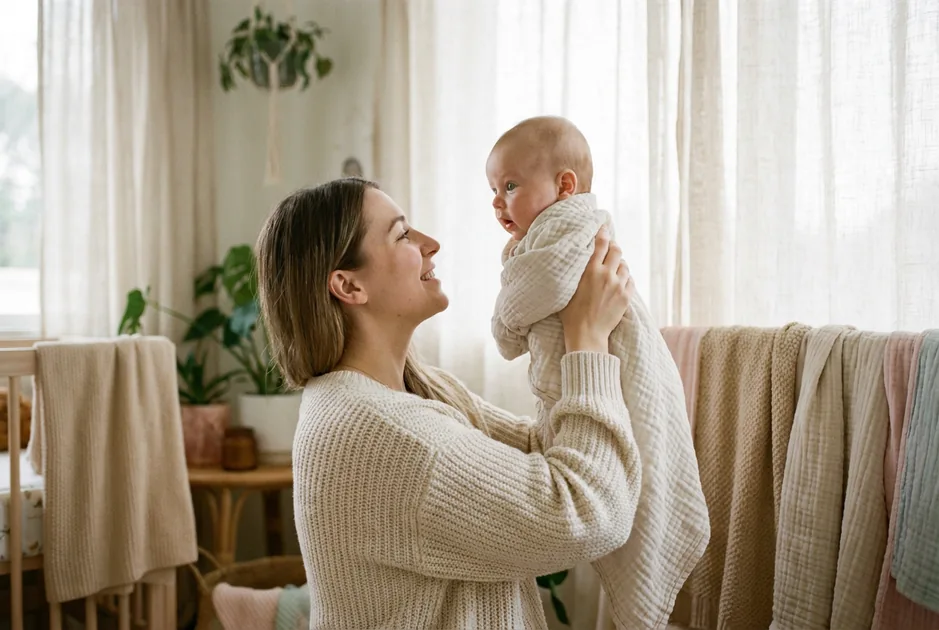
In the first days when you hold your baby in your arms, looking into their eyes, you often think: "I wonder if they see me? Do they recognize me?" Although babies' eyes are open from birth, their vision is not as fully developed as other sense organs (such as hearing and smell). The visual system undergoes a gradual development process that lasts for months or even years.
So, how does this miraculous process happen, from those first days when your baby sees the world as a "blur" to the months when they discover the world in all its colors? Let’s take a month-by-month look at the world through your baby's eyes.
Newborn period (0-1 month): Just you and a black-and-white world
In the first moments after birth, a baby's retina and the vision center of the brain are not yet fully mature. Their world is quite blurry, and they are very sensitive to light.
Focus distance: A newborn baby can see relatively clearly at a distance of only 20-30 cm. Miraculously, this is the distance between a mother's face and the baby's eyes while breastfeeding! Nature created this distance so that the baby can see the thing they need most—their mother.
Colors: In the first weeks, babies cannot distinguish colors. They see the world in shades of black, white, and gray. That is why high-contrast toys or cards (black-and-white checkered or striped) shown to them in the first months attract their visual attention more.
2-3 months: Awakening of colors and first tracking
From the second month, your baby's world begins to become a bit clearer and more colorful.
Discovery of colors: Color receptors in the eye (cones) begin to develop rapidly. Babies usually start to distinguish the color red first, followed by green, yellow, and blue. However, they still cannot distinguish between similar tones (for example, orange and red).
Eye tracking: Your baby can now track moving objects with their eyes. If you slowly move a colored toy from right to left in front of their eyes, you will see their eyes, and sometimes their head, move along with the toy.
Making eye contact: During this period, your baby can now look into your eyes for a long time and examine your facial expressions. This is the moment when the emotional bond between you deepens.
4-6 months: 3D world and eye-hand coordination
These months are a period of major leaps in visual development. The baby's visual acuity increases rapidly.
Depth perception (Stereoscopic vision): Having previously seen the world like a flat screen, the baby now begins to understand the depth of space by focusing both eyes at the same time (3D vision).
Grabbing and grasping: The development of depth perception allows them to calculate how far objects are. As a result, they can reach out and accurately grab a toy. This is the most important stage of eye-hand coordination.
All colors: Your baby can now distinguish almost the entire color spectrum, including pastel tones, as clearly as adults.
7-12 months: Freedom of movement and full clarity
In these months, which are the preparation period for crawling and first steps, the visual system becomes the baby's greatest guide.
Crawling incredibly develops both the baby's eye-hand and body coordination. They can now easily see their favorite toy at the other corner of the room, calculate the distance, and move toward it.
Their eye color finally stabilizes. By the age of one, a baby's vision reaches almost the same level as an adult's.
How can you support your baby's visual development?
First 2 months: Hang black-and-white contrast cards on the side of the crib or the changing table.
3-4 months: Hang colorful rotating mobiles over the crib so they can both discover colors and track them with their eyes.
Change their position often: Regularly change their position in the crib so they can look at different angles in the room. During the day, surround them with different toys on a rug.