
Pregnancy
Growth Spurts: Understanding Why Your Baby Is Suddenly Fussy
A scientific guide to understanding why your baby is suddenly fussy, hungry, and sleepless. Learn about growth spurts, their timing, and practical advice for parents on Anacan.

Your baby's sleep schedule is in order, feeding is normal, and you can finally get some rest. But suddenly, for no reason at all, everything changes. Your baby becomes restless, cries frequently, doesn't want to be put down, sleep is disrupted, and most importantly, wants to suckle constantly. For parents, this period can be quite exhausting and worrying. But don't worry, this situation is often an indicator of an important stage in your baby's development — a growth spurt.
In the mother tongue or folk language, these periods are sometimes called "attacks," but scientifically, this is a short-term period where the baby experiences both physical (increase in height and weight) and neurological (brain development and new skills) leaps. So, when do these spurts occur, what are the symptoms, and what should you do during this period? Let's examine the topic in detail.

1. What is a growth spurt and how does it happen?
Growth spurts are a natural and necessary part of a baby's development dynamics. During this period, real physical growth occurs in the baby's body — bones lengthen, muscle mass increases, and brain volume grows.
At the same time, neurological development spurts also occur. New neuronal connections are formed in the baby's brain, allowing them to perceive the world differently and gain new skills (e.g., increased visual distance, reacting to sound, crawling, etc.). Such rapid change stimulates the baby's nervous system, causing restlessness and sleep disturbances.

2. Main symptoms of a growth spurt
Although every baby is different, the most common symptoms observed during a growth spurt are as follows:
Frequent hunger (Classic symptom): Your baby gets hungry faster than their normal feeding schedule. This is a natural reaction to provide the energy the body needs for rapid growth.
Sleep disturbance: The baby sleeps less than normal, wakes up frequently, or has difficulty falling asleep. Because neurological development activates brain activity, the baby cannot sleep.
Restlessness and desire to be held: Rapid changes stress the baby, making them feel more insecure and needing their mother's arms more.
Emergence of new skills: At the end of the spurt period, you may see your baby doing something new (for example, sitting independently for the first time, reaching for an object, or making different sounds).

3. When do growth spurts occur?
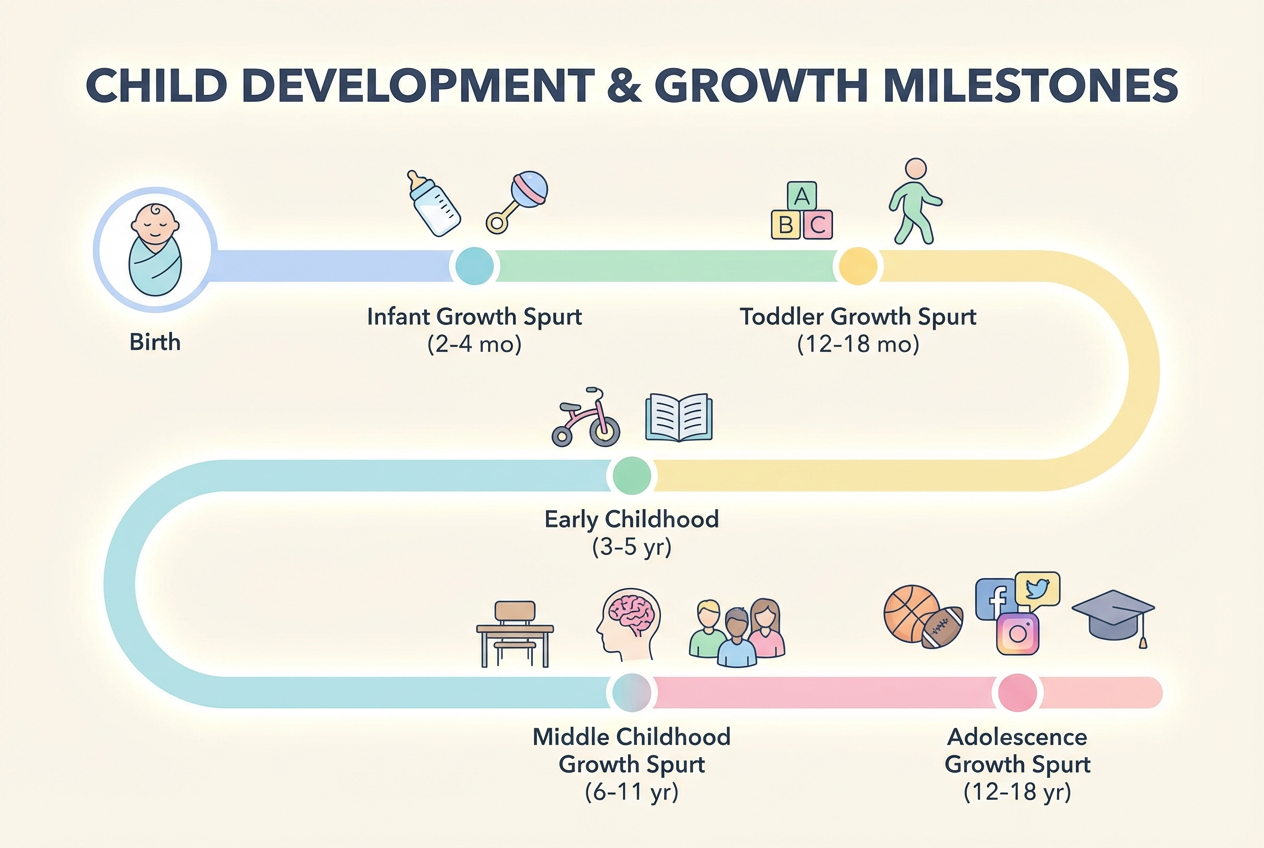
Although every baby is unique, experts have identified approximate times for growth spurts (attacks). These periods usually occur in the following weeks:
1-3 weeks
6-8 weeks
3 months
6 months
9 months
These time frames are approximate and may differ for each baby. Some spurts may last a few days, while others may last longer (e.g., 1 week).
4. What should parents do during a growth spurt?
Although this period is tiring, the greatest support you can give your baby is patience, love, and understanding. Here are practical tips for parents:
Feed on demand: Whenever your baby wants to suckle, feed them. Your breast milk (or formula) is the only way to meet their increasing energy needs. Frequent breastfeeding will also naturally increase milk production.
Be patient and resilient: Remember that your baby's restlessness is not conscious; they are simply struggling with the changes in their body. Give them more hugs, more love, and strokes.
Find opportunities to rest: Sleep when your baby sleeps. Postpone household chores or ask for support from your spouse. Protecting your own psychological and physical health is very important for your baby.
Get support from the app: By recording your baby's feeding and sleep hours, you can notice the growth spurt period sooner and be prepared for it.

Overcoming spurts together with Anacan
Remember that growth spurts are temporary periods. Everything that seems difficult today will be behind you in a few days, and your baby will amaze you with new skills. Through the "Crisis Calendar" section of the Anacan app, you can track growth spurt periods more systematically and pass through this period more comfortably by monitoring your baby's feeding frequency, sleep duration, and behavioral changes. Thus, you can provide your pediatrician with accurate, scientific information about their development. Anacan is always by your side!