Pregnancy
Game Recommendations: Fun Activities for Your Baby's Intelligence and Motor Skills Development
The best home games to support your baby's intelligence and motor development. Learn about tummy time by month, mirror games, and fun activities at Anacan.
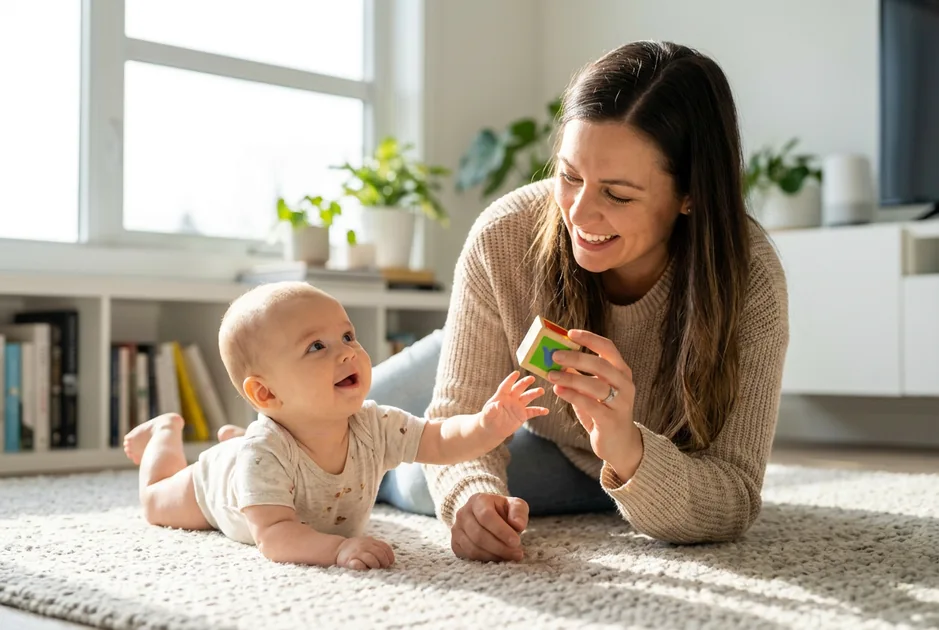
The small and simple games you play with your baby may seem like just a way to pass the time, but in reality, for them, play is the only way to learn and discover the world. Sometimes we think that expensive and noisy electronic toys are necessary for a child's development. However, scientific research shows that your baby's favorite and most educational "toy" is actually you—your tone of voice, facial expressions, and loving touches!
So, what simple and beneficial games can you play at home according to your baby's age (months)? Let's take a look at natural play activities that develop motor skills, cognition, and emotional intelligence.
0-3 months: Awakening of the senses and first bonds
During this period, your baby is just beginning to adapt to the external environment. The main goal is to gently stimulate their vision, hearing, and neck muscles.
Tummy time: Several times a day (while the baby is awake and full), place them on their tummy on your chest or a soft rug. Get in front of them and talk or show them a small object that makes a sound. This game strengthens their neck, shoulder, and back muscles, laying the foundation for crawling.
Mimicry game: Your baby can see your face very clearly from a distance of 20-25 cm. Stick out your tongue, open your eyes wide, or smile. After a few seconds, you will see them try to imitate you (for example, opening their mouth). This is their first form of social communication.
Contrast pictures: During these months, babies can distinguish black and white colors better. Placing cards with black-and-white geometric shapes on the edge of the bed or on a play mat increases their visual focusing ability.
4-6 months: Discovery, touch, and movement
Your baby has already discovered their hands, reaches for objects, and tries to identify everything by putting it in their mouth.
Introduction to mirrors: Place an unbreakable baby mirror in front of your baby. Even if they don't yet know it's themselves in the mirror, they will smile at the "other child" there and try to talk to them. This activity supports both visual development and self-awareness.
Different textures: Use clean items from around the house. A piece of silk, a light rustling paper, or a soft cotton towel... Touch these to your baby's hand and cheek in turn. Different sensations create new neural connections in the brain.
Music with feet: Put small, sound-making socks on your baby's feet. As they move their legs, they will notice the sound and begin to learn the "cause-and-effect" relationship (I move, sound is created).
7-9 months: Object permanence and preparation for first steps
Your baby, who is now starting to sit independently and practicing crawling, experiences a great leap in cognitive ability.
"Peek-a-boo" game: Cover your face with your hands or a towel, then suddenly open them saying "Peek-a-boo!" Babies laugh heartily at this game. The main scientific benefit is this: the baby learns that even if an object (or mother) disappears from sight, it does not disappear completely (this is called "object permanence" in psychology).
Obstacle courses: Place small obstacles consisting of pillows and soft toys in front of your crawling baby. The goal is for them to reach the target (for example, a favorite toy) by going over or around these obstacles. This develops problem-solving skills and gross motor skills.
Kitchenware concert: Give them safe plastic containers and a wooden spoon from the kitchen. Banging on the pots gives them great pleasure and strengthens hand-eye coordination.
10-12 months: Imitation and development of fine motor skills
Approaching one year of age, your baby now tries to copy everything you do and uses their fingers more skillfully.
Fill-and-empty game: Put various harmless objects (for example, colored blocks or large balls) into a box. Show them how to empty the box and then put the items back in one by one. This simple game perfects fine motor skills (the ability to grip with the thumb and index finger).
Flipping through books: Now, instead of just looking at pictures, let them turn the pages of thick (cardboard) books themselves. Support their language development by making the sound of the animal on each page (for example, "how does the dog go? woof-woof").